
Kind is a Verb

Who is the kindest person you know?
I have many kind people in my life, but a woman in my writing cohort stands out these days. She texts a simple note of encouragement on the days I need reminding that God is near. She prays, not just says she will, but really does. She asks what she can do to help me, even though she lives a thousand miles away. Last week, in a group coaching call, she prayed over me out loud, unprompted. What a blessing that was to me. She doesn't just say the right thing. She shows up, again and again, in ways that cost her something.
She is demonstrating the true, biblical meaning of "kind."
She isn't just kind toward me. She does it. And that's exactly the shift Paul makes in one of the most familiar verses about love.
Love is patient and kind.
1 Corinthians 13:4a NLT
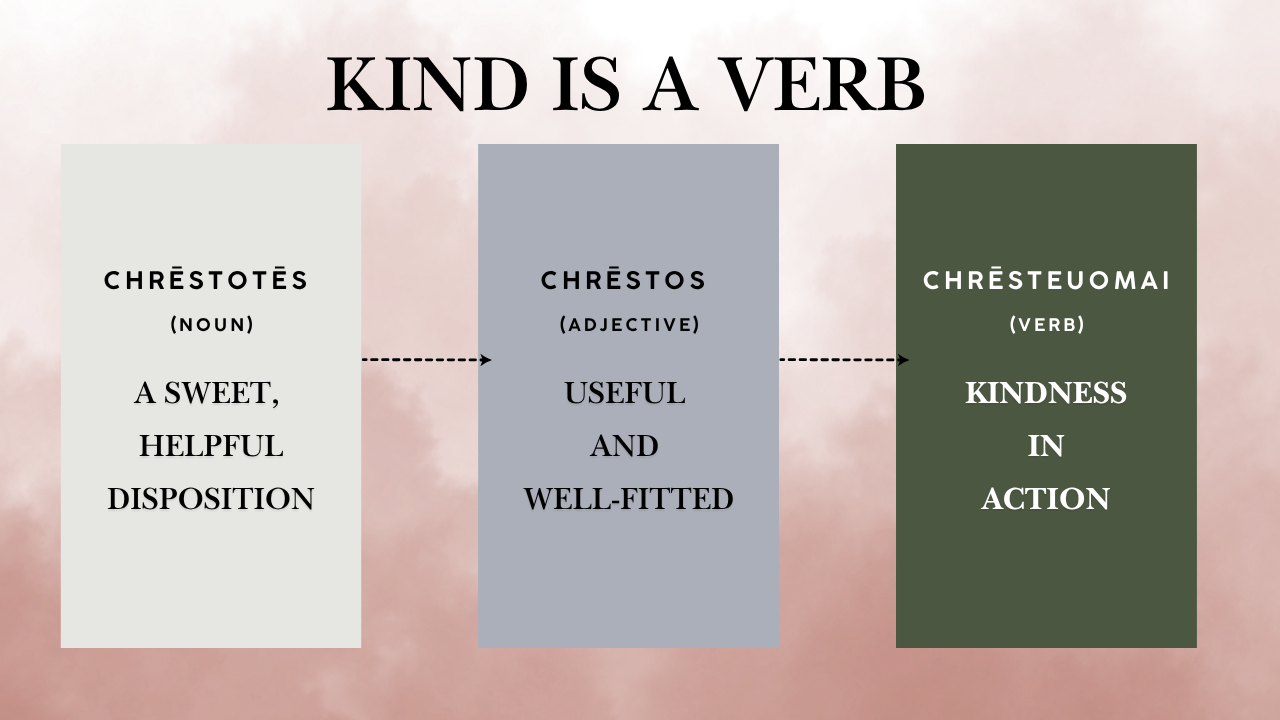
In this verse, Paul takes two familiar words and turns them into something new. Chrēstotēs is a noun that describes a sweet, helpful disposition, the same word used for the fruit of the Spirit in Galatians 5:22.
Chrēstos is an adjective meaning useful and well-fitted, the same word used for the easy, well-fitted yoke in Matthew 11:30.
Paul combines them into a verb, chrēsteuomai, to make his point: kind is an action.
This is the only place in the New Testament this verb is used. I think that's intentional.
The believers in Corinth had incredible spiritual energy and gifts, but pride and personal rivalries tore them apart.
If Paul had used "kind" as a noun, they would have proudly announced how generous and benevolent they were. If he had used the adjective, church members would have practiced kindness merely for social status, competing to out-give, out-help, or out-patronize rival groups.
So Paul turns kind into a verb. Love doesn't just have kindness as a trait, it does kindness, showing up as tangible help that meets a real need.
Behold, then Become
You can't strive to become kind. The only way to truly exhibit love by being kind is to behold God, who is love. We behold, then we become.
1 John 4:8 tells you that God is love. So in the description of love in 1 Corinthians 13, you are describing God.
- God is patient.
- God is kind.
- God is not proud.
- God is not rude.
When Paul says "love is kind," he's describing how God loves you. He meets you in a unique, well-fitted, real way, not a fuzzy, warm feeling, but an in-the-moment need, met.
How is God kind to you?
Over the last month, I have experienced God's kindness every morning. A member of our family is walking through a health crisis, and my heart cries out daily for God to encourage me through his Word.
I know from past experience that the one thing that turns me a hundred and eighty degrees, from facing fear to facing faith, is the Word of God. So every pre-dawn morning, before the house wakes up and the worry has a chance to get a word in first, I sit with my journal and ask God, what do you have for me today.
God has been so kind. He knows exactly what I need, and his way of loving me has been to fortify the Word of God in my life, one verse, right on time, again and again.
Some mornings it's a single line I've read a hundred times before that suddenly means something new.
Other mornings it's a verse I didn't know I needed until I read it.
Either way, it's never generic. It's fitted to me, to that morning, to that fear.
That's chrēsteuomai. That's kindness as a verb. It's what my friend in the writing cohort has been doing for me all along, without ever using the word.
God wants to show his love to you today through being kind. He takes the truth of the noun chrēstotēs, his patience and tender mercies, and adds in the adjective chrēstos, bearing the yoke beside you that fits you perfectly, and makes it real in your life through the action verb chrēsteuomai.
This is true kindness.
Behold how God is kind to you, and then become kind to others.
Send the text. Pray the prayer, not just the promise of one. Show up for the person a thousand miles away. You won't have to strive for it. You'll just be doing what you've already beheld.
Check out Becky's Latest News: Books, Coaching Courses, Podcasts
Author and Self-Pub Coach

